- Industries > Industrial Equipment
CPQ for industrial equipment manufacturers
Different equipment. Different rules. One quoting process.
From hydraulic equipment to compressors and modular machinery, every product family has its own options, technical rules and pricing. Mercura brings them into one guided sales process without forcing different products into the same configuration model.
Illustrative families · Not a live catalogue
- 01 Hydraulic Load, geometry and accessories
- 02 Compressors Flow, pressure and controls
- 03 Modular Platform, modules and services
Shared commercial process
- Select family
- Apply its rules
- Price
- Prepare the quote
One catalogue. Many ways to configure.
An industrial equipment manufacturer does not configure a compressor with the same questions as a hydraulic product. Mercura keeps a model per family and lets sales follow one commercial process.
Load, geometry and accessories
Questions for that family
- Capacity
- Dimensions
- Operating setup
- Compatible accessories
Kind of rule
Which capacity, geometry and accessory combinations that catalogue allows.
Commercial output
A hydraulic variant, with its price and commercial scope.
Flow, pressure and controls
Questions for that family
- Flow class
- Pressure
- Equipment variant
- Controls and accessories
Kind of rule
Which variant and accessory fit the pressure and flow range you have modeled.
Commercial output
A configured compressor, not a rule borrowed from another family.
Platform, modules and services
Questions for that family
- Base platform
- Modules
- Dimensions
- Options and services
Kind of rule
Which modules that platform can carry, and which services belong on the quote.
Commercial output
A modular assembly with equipment and service lines.
Industry examples, not Mercura catalogue records. This view has no price and no engineering result.
When every product family has its own sales rules
The difficulty is not one machine. It is keeping a broad catalogue sellable without one spreadsheet per family.
- 01
Product knowledge stays with a few people
Standard options can follow rules engineering has already defined. A request outside that model still needs an engineer.
- 02
Each family has its own process
Separate workbooks and quote templates drift. Mercura can keep the commercial sequence consistent while each family keeps its own logic.
- 03
Pricing is copied, not controlled
Base equipment, options, customer price lists, regional prices, discounts and services can live in the pricing model you configure. Mercura does not invent a margin rule you have not set.
One sales process. The right rules for every product.
The steps can stay the same. The questions and the constraints change with the family.
- 01 Select the product family Hydraulic equipment, a compressor and a modular assembly do not start from the same form.
- 02 Capture the application Ask only for the requirements that family uses.
- 03 Apply that family's rules Compatibility and dependencies come from the model for that product, not from a shared engineering formula.
- 04 Price the configuration Use the price list, options and conditions configured for the account.
- 05 Prepare the quotation The commercial document follows the accepted configuration.
- 06 Hand off what was sold Sales, engineering and the customer can refer to the same configured scope. Exceptions still go to engineering.
Published case
AC Hydraulic already configures one family on its own rules.
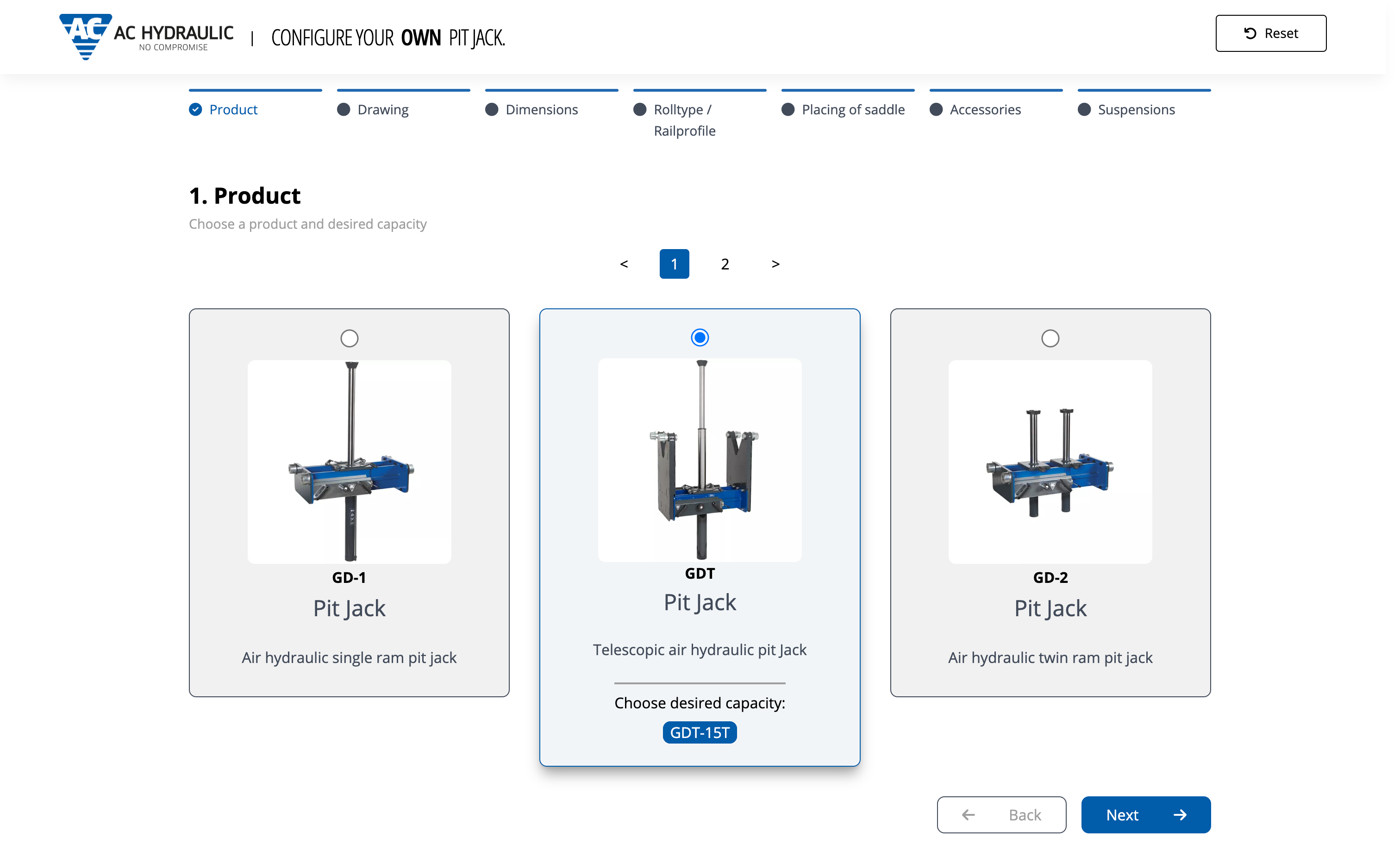
AC Hydraulic builds pit jacks. The configurator asks for capacity, pit type, dimensions, roll type, rail profile, saddle placement and accessories, then recommends the suspension that matches those criteria. Customers and dealers walk through that selection. It is not a universal model for compressors, or for the rest of an industrial catalogue.
Read the AC Hydraulic caseWe needed a web-based product configurator to manage our complex suspension selection efficiently. Mercura delivered a solution tailored to our needs. The configurator simplifies our sales process.
A different product, different rules: the Migatronic CoWelder configurator applies more than 1,000 constraints. It does not share AC Hydraulic's logic. Read the Migatronic case
Less time rebuilding quotes. More control over what gets sold.
Before
- Each family keeps its own catalogue file.
- Price comes from a local spreadsheet.
- Standard compatibility is checked by whoever remembers it.
- Quote documents do not match the last revision.
With Mercura
- Each family has its own product model.
- Sales follows a guided configuration for that model.
- Pricing uses the commercial rules you maintain.
- The quotation stays tied to the accepted configuration.
What the families share is the process, not the engineering.
- Family models
Each family keeps its own configurable structure.
- That family's rules
Manufacturer-defined constraints and dependencies.
- Commercial pricing
Price lists, options and conditions you have configured.
- Quotation
The document comes from the accepted configuration.
- Dealers
A partner channel can use approved products and price lists, when you implement one.
- ERP and CRM
Connecting a business system is an implementation project.
Questions from manufacturers with more than one family
What a shared sales process can do, and what it does not standardize.
Can Mercura handle different types of industrial equipment?
Yes, as separate product models in one commercial process. A hydraulic family and a compressor family do not have to share questions, options or constraints. A single-product manufacturer is usually better served by the page for that equipment, such as pumps or CNC machines.
Do all product families use the same configuration rules?
No. Shared process does not mean shared engineering rules. Each family can have its own parameters, options and constraints.
Can Mercura use our existing product and pricing data?
The catalogue and the price conditions are implemented in Mercura. There is no automatic migration of every spreadsheet, drawing or ERP record.
Can distributors configure products with our approved rules?
A dealer channel can expose approved products and the relevant price list, with access limited to that partner. It is part of the implementation, not a switch on this page. AC Hydraulic's published configurator is one example of customers and dealers selecting within a modeled family.
What happens with an exceptional configuration?
Modeled, standard configurations follow the rules you maintain. A request outside that model stays with engineering. Mercura does not approve a one-off design.
Next step
Your equipment. Your product rules. One sales process.
Show us the product families, configuration rules and pricing behind a typical quotation. We will look at how those decisions can sit in one guided process.
A single equipment family has its own page: pumps and fluid systems, CNC machines, conveyors, mixing equipment, valves and fittings.
Platform: CPQ for manufacturers, product modelling, configuration.
Not ready to talk yet? Watch a short walkthrough or ask a question below.
Request a CPQ demo